 Skip to content
Retirement Goals Through Ongoing Financial Planning Services
As a boutique, high-touch wealth management firm, Montecito Capital Management has built its reputation on guiding clients through some of the most pivotal financial transitions of their lives.
With decades of expertise, a disciplined investment philosophy, and a commitment to individualized planning, we help clients transform uncertainty into clarity, especially as they approach retirement.
From Accumulation to Income-Based Living
The most frequent question we receive from individuals nearing retirement is whether they can afford to retire, followed closely by what their retirement budget should look like and how to navigate the range of Medicare options.
Fortunately, this is precisely the work we specialize in. We provide retirees with clear, data-driven insight into what their financial future is likely to hold as they shift from accumulation to an income-based lifestyle.
Beyond designing diversified, retirement-focused income portfolios, we work hands-on with clients to build budgets grounded in their income sources, anticipated expenses, and long-term financial goals.
Retirement Planning Support
Data-driven insight for the transition into retirement.
Retirement Planning Topics
Use these sections to review the full retirement planning framework.
Execution Is Just as Critical as the Plan Itself
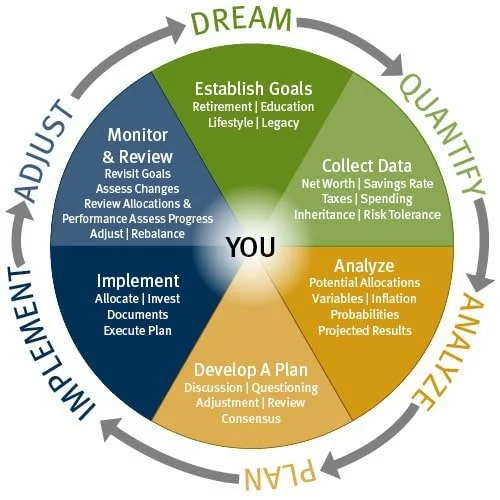
A well-crafted financial plan only creates value when it is executed effectively with periodic reviews. Too often, we see that after a plan is delivered, many recommendations are either delayed, overlooked, or not acted upon at all.
In other cases, steps are taken but executed incorrectly, undermining the strategy’s intended benefits. Financial planning is inherently complex, involving tax considerations, investment decisions, estate strategies, retirement income planning, and risk management.
Each element is interconnected, meaning an error, or even a slight misstep, can have ripple effects across the entire plan.
The cost of inaction or incorrect execution can be severe: missed opportunities for tax efficiency, compromised retirement security, or unnecessary exposure to financial risk. That’s why proper follow-through is not just recommended. It is essential.
Common Risk Areas
Delayed implementation after financial plan delivery
Incorrect account titling or beneficiary designations
Tax inefficiency and missed planning opportunities
Portfolio risk drift and inappropriate allocations
Failure to review and adjust as life changes
Portfolio Design for Lifestyle, Income and Future Needs
Your investment returns and current lifestyle costs are interrelated and must be reviewed to accomplish your retirement goals. Every retiree’s financial journey is different, which is why an advisor builds a portfolio that is personalized to your unique situation.
Factors like how much income you’ll need each month, your goals for growing or preserving your financial assets, the size of your nest egg, and even your comfort level with market ups and downs all play a role.
The result is a retirement plan designed to support your lifestyle today while keeping an eye on the future.
For some retirees needing income, we create portfolios to generate cash flows in the most effective, efficient ways possible to deliver steady income that meets lifestyle objectives.
Retirees benefit from income portfolios that draw on multiple sources of yield and return streams. We also offer reduced advisory rates for retirees living solely on a fixed income, given these portfolios typically do not have material growth components.
Understanding Sequence Return Risk
The most important risk in your portfolio is time, particularly the decay of opportunities for greater total return or recovery from losses as you move toward the golden years.
Sequence return risk refers to the danger of experiencing poor investment returns early in retirement. If your portfolio experiences decline early in your retirement, and coincides with you taking retirement income withdrawals, it becomes increasingly difficult to make up that lost ground over time.
In other words, when withdrawals are happening at the same time, these early losses can quickly erode a nest egg and increase the likelihood of running out of money.
The sequence of returns matters far more during the retirement distribution phase than in the accumulation phase, because retirees have less time for their portfolios to recover from downturns. This reinforces the rationale to have a competent professional advisor help mitigate potential loss while aligning with return goals.
Early Losses Matter
Losses early in retirement can permanently weaken a portfolio when withdrawals are also occurring.
Distribution Phase Risk
Retirees have less recovery time, so return order matters more than during accumulation.
Advisor Oversight
Professional guidance helps align risk controls, income needs, and return objectives.
Importance of Correct Plan Implementation
We have found that following the delivery of a financial plan, often times many of the recommendations do not get implemented for one reason or another. Sometimes recommendations do get implemented, albeit incorrectly.
Financial planning can be extremely complex, and because of the severe negative consequences that can result, it is imperative that certain recommendations get implemented correctly.
For example, improper beneficiary designations can negate estate intentions, incorrect account titling can trigger unintended tax consequences, and poorly executed investment allocations can alter the portfolio’s risk profile.
In short, designing a financial plan is only half the journey. The true impact comes from disciplined, precise, and timely implementation.

Financial Planning Needs Ongoing Monitoring and Adjustments
According to an Allianz study, 92% of Americans working with a financial advisor say that person is helping them reach their financial goals and 86% say their advisor relieves the pressure of trying to plan their family’s financial future by themselves.
Financial planning without ongoing monitoring and adjusting is like running a marathon once and believing that you are going to be in great shape for the rest of your life.
Cornerstone of Retirement Planning is Financial Fitness
This service maintains your financial fitness through ongoing plan updates, detailed tracking, reports, task lists, education, allocation reviews, tools, implementation support, answers to planning questions, and research commentary.
Financial Fitness Includes
Annual updates to your financial plan
Close tracking of every detail of your personal financial situation
In-depth reports and task list
Taking you through the investment process in two to three meetings
Periodic asset allocation checks
Access to Web-based retirement planning tools
Implementation of recommendations within days after engagement
Answers to financial planning-related questions
Important articles, research and commentary by email

Evaluating Income Sources in Retirement
Retirement income planning requires a full review of income sources, household assets, projected benefits, investment income, and potential risks.
Social Security, estimates of retirement, disability, and survivors benefits
Pensions and possible inheritances
Retirement scenario calculations to see if you’re saving enough
Value of real estate, personal property, antiques, collectibles, and business interests
Annuities, we do not sell annuities, however, we neutrally evaluate them
Life insurance values, if any
Income from investments and retirement funds including stocks, bonds, trusts, and real estate
Retirement Lifestyle & Decision Making
Deciding when and where to retire is one of the most important decisions of our lives. Retirement is not just about leaving a job. It is about stepping into a new chapter with confidence and purpose.
Alternatively, if you’re already retired, you should continue to reassess your situation and be ready to adapt to changing conditions.
You are financially prepared, with enough savings to support your lifestyle
You have a Social Security strategy in place to maximize your benefits
You have eliminated or significantly reduced debt before leaving the workforce
You have a clear plan for covering healthcare expenses
You feel emotionally ready to step away from your career
You know how you will spend your time through hobbies, volunteering, travel, or family


Reverse Mortgages Guidance, Pros & Cons
We also advise on reverse mortgages as an option to turn equity into cash while still living and owning your home. However, insofar as the loan products are complex and fraught with the good, the bad and the ugly, this access to home equity might be suitable for those running out of money and want to still own a house, continue to live in their home and have the house still appreciate as an investment.
Tax Considerations in Retirement
There are unique tax considerations that are specific to retirees. For example, Social Security income, partial IRA conversion, tax efficiency in allocation, deferment strategies, and more.
With tax-qualified retirement plans like 401(k)s and traditional IRAs, contributions are made with pretax dollars. This means you don’t pay taxes when you put the money in. Instead, taxes are deferred until withdrawal, often decades later.
Earnings and growth within the account are also tax-deferred. Distributions typically begin between ages 59½ and 73, and the amounts you withdraw are taxed as ordinary income at your regular tax rate.


Avoiding Retiree Regrets
Top retiree regret? Not doing it sooner. While postponing retirement may bring financial advantages, many retirees later regret prioritizing money or workplace benefits over personal time.
As health and energy naturally decline with age, their ability to fully enjoy retirement often diminishes.
So what can investors do to improve the odds of retiring earlier? Invest more, sooner, avoid high debt, plan early, and build a roadmap with a financial advisor.
Retirement Income Withdrawal Rates
Modern financial retirement approaches have recognized the need to smooth withdrawals and use strategies like Guyton/Klinger rules to set outer boundaries.
A commonly cited guideline for retirement spending is the 4% rule. The idea is straightforward: in your first year of retirement, withdraw 4% of your total investments. Each year after, adjust that amount for inflation.
According to the rule, this approach gives you a strong chance of making your savings last through a 30-year retirement.
No matter how you look at it, one of the biggest mistakes with the 4% rule is assuming it must be followed exactly. Instead, it is best used as a starting point, a simple guideline for retirement planning.
For example, if you want $40,000 in your first year of a 30-year retirement, adjusted annually for inflation, the rule suggests you’d need $1 million saved.
Beyond that, however, a personalized spending rate, tailored to your circumstances, investments, and risk tolerance, and updated regularly, is a smarter approach.
Retirement Planning Contact
Telephone: (805) 965-7955
Email: ContactUs@McapitalMgt.Com
Serving: San Luis Obispo County, Santa Barbara County, Ventura County, Los Angeles County & Orange County
Not all clients require comprehensive financial plans as the considerations for such plans are partly determined by current financial assets, future economic standing and the degree of each individual’s existing planning of their own financial affairs. Also, some clients decide to forgo a detailed financial plan and prefer an overview of assets, income, expenses, health and insurance policies to determine their prospective financial stability and retirement timeline.
Financial Planners & Retirement Advisors serving San Luis Obispo County, Santa Barbara County, Ventura County, Los Angeles County & Orange County.
The website provides general information regarding our business along with access to additional investment related information. Material presented on this website is believed to be from reliable sources and is meant for informational purposes only. The intent is to provide helpful information, which should not be construed as investment advice. We do not guarantee its accuracy, nor completeness, and it is not intended to be the primary basis for investment decisions.
We do not make personal investment recommendations to people or entities except to those who have engaged us expressly for the purpose of providing professional investment advisory services. Investing involves risk and possible loss of principal capital. Montecito Capital Management Group’s ADV filing is available online at adviserinfo.sec.gov and current FORM ADV Part 2, which describes the services offered, fees charged and detailed company information, among other things, is available upon request free of charge.
We are limited in our fiduciary capacity by the firm’s non-discretionary client relationship, whereby the client dictates the investment parameters and contractually agrees to accept sole responsibility for their choices.
Trusted Guidance for Long-Term Financial Success
Every client has a different financial picture, but the need for clear advice, disciplined planning, and dependable support remains the same. Montecito Capital Management provides fiduciary wealth management designed to help clients move forward with confidence.
Posted on Google
 Laura nolan
Trustindex verifies that the original source of the review is Google.
Our family has worked with this financial advisory firm for several years, and the experience has been outstanding. They take the time to truly understand our goals and explain everything clearly, without jargon. Their guidance has helped us feel confident about our investments and long-term plans. Highly recommend them for anyone looking for trustworthy, personalized financial advice.Posted on Google Jennifer ObrienI've worked with my advisor for several years now and the difference in my financial confidence is night and today . They take the time to understand my long term goals explain strategies clearly and consistently follow through from investment management to financial plan and estate coordination kip has brought structure and clarity to every part of my financial picture. I've never felt rushed or sold to just genuinely advised. Highly RecommendedPosted on Google
 Frank GeivelisI used to feel scared tax season and wasn't sure whether my investments were even working for me. The advisor looked at everything found costs didn't know i was paying and cganged my portfolio so that it was based on long term goals instead of short term trends. What i liked best was how they kept teaching me as we went along. Clarifying each choice until it made sense. For the first time in years i feel like i have everything togather am sure of my self and am in chargePosted on Google
 Leslie GulliksonKip is highly qualified, knowledgeable and responsive. It's reassuring to wealth advisor I have confidence in.Posted on Google
 Mark WilsonVery hands-on, knowledgeable and well-thought out investment (& retirement) planning. The fees are fair, and lower than the others advisors I met during my vetting process. I like that Kip Lytel, my advisor, is always very responsive and actively tracks economic data, earnings, stocks, bonds, valuations, politics and everything that might impact my portfolio. Happy with results!Posted on Google
 Paul TurnerAn overall amazing advisory firm.Posted on Google
 Josie PughOutstanding advisory experience. Very patient, good returns overall and helps with my other asset decisions.Posted on Google
 Daniel ElliotTruly excellent investment advisory services. Kipley and the team have an incredible depth of knowledge, and it shows not only in their performance, but in their frequent articles and newsletters, and their clear, understandable responses to questions. I've never been anything less than satisfied.Verified by TrustindexTrustindex verified badge is the Universal Symbol of Trust. Only the greatest companies can get the verified badge who has a review score above 4.5, based on customer reviews over the past 12 months. Read more
We Would Love to Have You Visit Soon
Hours: M-F: 6:30am-6:00pm
Telephone: 1-805-965-7955
Email: contactus@mcapitalmgt.com
Serving Santa Barbara County & Ventura County
Address: 225 East Carrillo Street, Suite 203
Santa Barbara, CA 93101
Serving Los Angeles County & Orange County
Address: 522 South Sepulveda Boulevard, Suite 207
Los Angeles, CA 90049
Move Forward With Clear, Disciplined Financial Guidance
We Would Love to Have You Visit Soon. Monday to Friday, 6:30am to 6:00pm.
