Author, Kip Lytel, CFA
Montecito Capital Management
Weekly Market Summary — Week Ending January 30, 2026
U.S. equities finished the week with relatively modest index moves, but the tone of the market shifted in an important way beneath the surface. What began as a steady, earnings-supported environment evolved into a policy-driven repricing event late Friday, leaving investors more cautious heading into February.
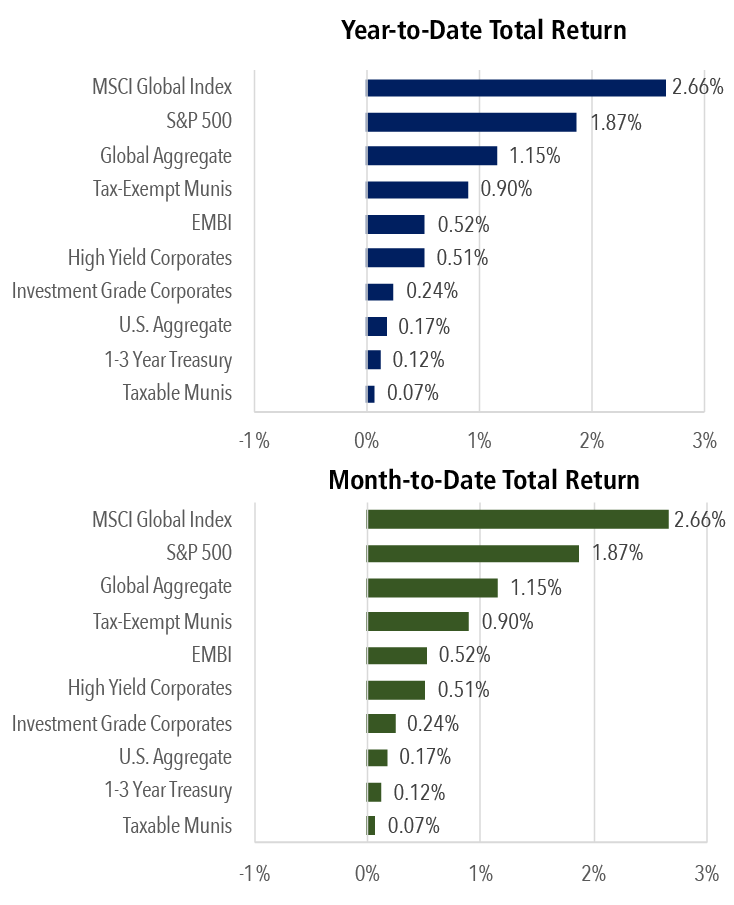
For the full month of January, the broad averages finished strongly despite Friday’s volatility: the S&P 500 climbed roughly +1.4% on the month, the Dow Jones rose about +1.7%, and the Nasdaq Composite gained around +0.9% through the end of January. Those monthly gains reflected both renewed AI optimism and solid earnings momentum earlier in the month before the late-week repricing.
Looking at just last week’s action, the S&P 500 managed a modest +0.3%, the Dow slipped roughly −0.4%, and the Nasdaq finished about −0.2% as investors assessed shifting monetary policy expectations.
From Steady Fundamentals to Policy Repricing
Through midweek, the market was anchored by fundamentals: corporate earnings continued to come in better than feared, keeping profit growth prospects intact even in a higher-rate regime. Inflation indicators pointed to continued but uneven disinflation — enough to avoid triggering panic, but not enough to lock in earlier rate-cut bets. This allowed risk assets to trade with relatively calm volatility and kept credit spreads stable.
That equilibrium shifted late Friday.
Fed Leadership Shift and Cross-Asset Reaction
Friday’s defining catalyst was the announcement that President Donald Trump intends to nominate Kevin Warsh as the next Federal Reserve Chair. Traders reacted not just to the name, but to what the nomination implied about future policy direction.
Warsh has a reputation for institutional credibility and caution on inflation risks. Markets had been pricing increasing odds of early rate cuts as inflation moderated, but the nomination raised questions about how quickly — or how much — the Fed might ease. Coupled with political uncertainty around the transition, this prompted investors to reassess the timeline for monetary accommodation.
The result was a rebalancing in positioning — equities softened into the close as traders reduced duration and trimmed risk exposure. It wasn’t a broad market sell-off, but rather a reset of entrenched expectations as the policy trajectory came back into focus.
Gold, Silver and the U.S. Dollar — Sharp Moves on Friday
The sharpest reactions were in precious metals and the dollar.
Gold and silver experienced particularly large single-session moves on Friday:
- The SPDR Gold Shares ETF (GLD) dropped approximately 8–11% on Friday alone, reversing a significant chunk of its recent gains.
- The iShares Silver Trust (SLV) plunged even more violently — roughly 20–30% in one session, one of the steepest declines in recent memory for any major metal ETF.
These outsized moves reflected the unwinding of crowded positions that had built up around anticipated rate cuts and broad hedge behavior. Once that narrative shifted, profit-taking accelerated.
At the same time, the U.S. dollar strengthened noticeably into the close of the week. The U.S. Dollar Index (DXY) rallied by about 0.5–0.9% on Friday, reversing earlier weakness and acting as a headwind to dollar-priced commodities like gold and silver. A firmer dollar is consistent with markets stepping back from aggressive easing — higher or steadier real rates tend to support the currency and pressure non-yielding assets.
In short, the market’s cross-asset response was a clear rebalancing away from bets on imminent policy accommodation and toward a stance that puts greater weight on policy risk and timing uncertainty.
What the Week Signals
Nothing in the underlying economic data fundamentally deteriorated last week. Growth did not collapse, inflation did not reaccelerate, and the earnings backdrop remained constructive. What changed was the perceived path of monetary policy, which now appears less certain and potentially less accommodative than markets had priced just days earlier.
The key takeaway for investors is that expectations around policy leadership and timing remain a dominant driver of cross-asset behavior. Monthly returns for the major indexes showed broad gains, but the late-week repricing underscores how quickly sentiment can swing when assumptions about the policy trajectory shift. Asset allocators exiting January are now more alert to policy uncertainty, positioning risks, and the pace of future Fed action — themes likely to remain front and center in the weeks ahead.