Montecito Capital Management: Weekly Market Update – Week Ending Friday the 13th
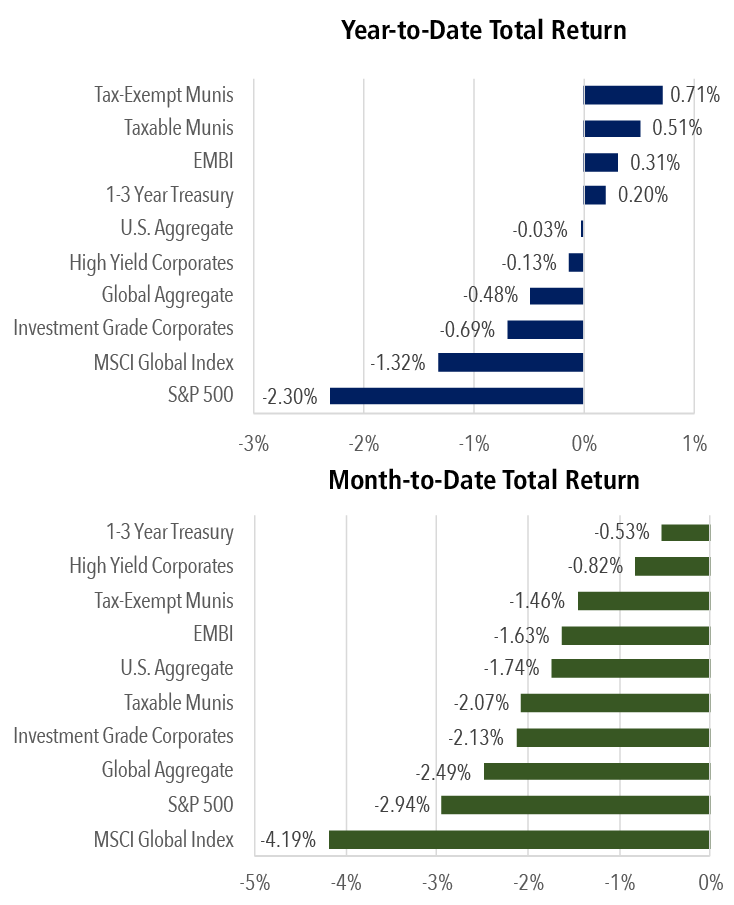
It was an appropriately unlucky week for markets, with risk assets retreating amid geopolitical tensions, softer economic data, and renewed volatility in energy markets. For the week ending Friday the 13th, U.S. equities declined across the board as investors digested a mix of disappointing economic indicators and escalating tensions in the Middle East that disrupted key shipping routes. The S&P 500 fell roughly 1.4%, the Dow Jones Industrial Average declined 1.1%, and the technology-heavy Nasdaq slipped 1.9%. Small-cap stocks were particularly weak, with the Russell 2000 falling nearly 2.2% as investors moved toward larger, more defensive companies.
One of the primary drivers of volatility this week was the surge in oil prices following renewed attacks on commercial shipping in and around the Strait of Hormuz, a critical chokepoint through which roughly one-fifth of the world’s oil supply passes. Several transport vessels were targeted, raising fears of broader disruptions to global energy flows and supply chains. As a result, crude oil prices jumped during the week, pressuring transportation and airline stocks while raising concerns about renewed inflation pressures should the conflict escalate further.
Despite the recent spike in crude prices, the broader economic impact may be more limited than in past decades. First, the pass-through of higher oil prices to core inflation has been relatively limited in recent years. Second, while rising energy costs can weigh on consumer spending power, it typically requires sustained elevated prices—often for several months or more—to materially erode income growth. Third, the U.S. economy has become significantly less dependent on oil; overall oil intensity has fallen by roughly 66% since 1965, driven by greater energy diversification and the long-term shift from manufacturing toward a more service-oriented economy. Fourth, the United States has transitioned from a net petroleum importer to a net petroleum exporter, which helps insulate the domestic economy from global oil price shocks compared with past decades.
Economic data also contributed to the market’s cautious tone. Updated GDP estimates came in softer than expected, suggesting the U.S. economy may be losing some momentum after a strong run last year. While growth remains positive, the downward revision reinforced concerns that the cumulative effects of higher interest rates are beginning to slow consumer spending and business investment.
Additional economic indicators painted a similarly mixed picture. Manufacturing surveys continued to show contraction in several regions, reflecting weak global demand and elevated borrowing costs. Meanwhile, consumer sentiment readings slipped modestly, as households continue to grapple with higher prices for essentials such as housing, insurance, and energy. Labor market data remained relatively resilient, though job openings have gradually declined from their post-pandemic highs, signaling a more balanced — though still healthy — employment environment.
Interest rates were relatively stable during the week, with Treasury yields fluctuating modestly as investors reassessed the likely path of Federal Reserve policy. While inflation has generally trended lower over the past year, rising oil prices and persistent service-sector inflation could complicate the Fed’s timing for potential rate cuts later this year.
Looking ahead, markets will remain highly sensitive to developments in the Middle East, particularly any further disruptions to energy infrastructure or global shipping routes. At the same time, investors will continue monitoring incoming economic data for signs of whether the economy is cooling toward a sustainable pace or slipping into a more pronounced slowdown.
Periods like this—where geopolitical risk intersects with shifting economic momentum—often produce short bursts of volatility. However, they also tend to create opportunities for disciplined investors focused on long-term fundamentals rather than short-term headlines.